In today’s fast-paced economy, enhancing your cash flow health quickly is more essential than ever. Companies often overlook the hidden costs of slow asset turnover: tied-up inventory, delayed payments, and thinning margins. By mastering the art of converting assets into cash, businesses can build resilience, seize growth opportunities, and navigate uncertainties with confidence. This article dives deep into the core mechanics of cash conversion and offers actionable strategies to reduce your working capital demands, ensuring you maintain a robust financial position at every stage of operations.
Whether you run a small startup, a growing mid-market enterprise, or an established corporation, understanding the underlying principles of the Cash Conversion Cycle (CCC) can transform the way you manage liquidity. From inventory management to supplier negotiations, every decision impacts your ability to access cash when you need it most.
The concept dates back to 1980 when Verlyn Richards and Eugene Laughlin introduced the CCC framework, emphasizing the critical role of time in liquidity analysis. By incorporating the duration of each operational phase, they provided a more nuanced view of financial health. Today, mastering this cycle is crucial not just for large corporations but for small and medium-sized enterprises seeking to build long-term financial stability and weather unforeseen challenges.
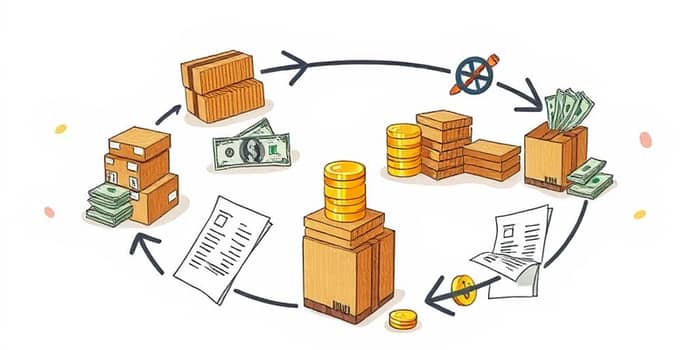
The Cash Conversion Cycle (CCC) measures the average number of days it takes to convert raw materials into finished products, sell those products, and ultimately receive cash from customers, while accounting for the period you take to pay suppliers. Represented by the formula:
CCC = DIO + DSO - DPO
where:
Each component tells a story about your operational efficiency. A shorter DIO suggests brisk inventory turnover, while a lower DSO indicates prompt customer payments. Extending DPO without straining supplier relationships frees up funds longer. Together, these metrics reveal how effectively you can turn assets into immediate capital and maintain a competitive financial edge.
Some trailblazing companies achieve a negative Cash Conversion Cycle by turning over inventory rapidly and collecting payments before paying their suppliers. This rare scenario effectively means suppliers finance your operations, providing a continuous influx of cash that can drive aggressive growth strategies and competitive expansion.
Reducing the Cash Conversion Cycle yields significant impacts across your organization. Faster cash recovery means you seize strategic opportunities instantly, avoid expensive credit facilities, and strengthen your negotiating power with suppliers and lenders. Improved liquidity also provides a buffer against market volatility, unexpected expenses, and cyclical downturns.
Financial flexibility gained from a shorter CCC can fund new projects, support marketing campaigns, or simply improve your bottom line by lowering interest costs on borrowed capital. In essence, a streamlined cycle amplifies every dollar in reserve, making your enterprise more agile and robust.
Consider a real-world example: Markham Corporation holds inventory for 30 days, collects receivables over 60 days, and pays suppliers in 20 days. Their CCC calculates to 70 days, meaning capital is tied up over two months before replenishment. By reducing DIO by just 10 days, DSO by 15 days, and extending DPO by five days, they can shrink the cycle to 40 days, resulting in immediate cash savings and stronger funding for operations.
One of the most impactful levers within the CCC is inventory management. Identify and liquidate slow-moving stock to free up cash and avoid storage costs. Begin by analyzing an aging inventory report to spot items stuck in warehouses for extended periods.
Then, deploy targeted actions:
Additionally, consider implementing a Just-in-Time (JIT) approach where you receive materials only as needed. This methodology minimizes stock levels, reduces warehousing costs, and optimizes every stage of operations. Forecast demand using historical sales data and market trends, and conduct regular cycle counts to ensure accuracy. Inventory management tools integrated with your accounting software can set reorder points, forecast demand, and ensure you hold only necessary stock.
Accelerating customer payments is another cornerstone for improving liquidity. Simplify and streamline your invoices to encourage faster settlements. Ensure each invoice is clear, concise, and sent immediately upon delivery of goods or services.
Offering varied payment options—credit cards, digital wallets, direct debits, or bank transfers—reduces friction and caters to customer preferences. A dedicated payment portal can further simplify the process, leading to consistent and timely cash inflows.
Train your sales and customer service teams to emphasize payment terms at the outset of every contract. Automated reminders and friendly follow-up calls can reduce overdue invoices significantly. If your DSO remains high, invoice financing or factoring can be an effective interim solution. By selling unpaid invoices to a third-party financier at a discount, you can access immediate cash, significantly lowering your effective DSO and unlocking working capital.
Even as you focus on quick turnovers, you can also optimize how long you take to pay suppliers. Auditing current payment terms across your vendor base reveals opportunities to negotiate extensions without damaging key relationships. Focus first on non-critical suppliers where you hold leverage.
Balance extended terms with supplier satisfaction. Offer to consolidate larger orders or commit to longer-term contracts in exchange for more favorable payment schedules. This dual-value approach fosters partnerships where both parties benefit from improved cash flow management. By strategically extending DPO, you can preserve cash within your business longer while still meeting operational needs.
Transforming your CCC requires a structured, data-driven approach. Begin with an audit to calculate your current DIO, DSO, DPO, and overall CCC. Identify the largest bottleneck—whether it’s inventory, receivables, or payables.
Develop a phased roadmap: Month 1: Establish baseline metrics and set clear, measurable targets. Month 2-3: Execute prioritized strategies—liquidate old inventory, refine invoicing, negotiate supplier terms. Months 4-6: Evaluate results, adjust tactics, and consider automation tools for scalable gains.
Set up key performance indicators (KPIs) tied to each component of CCC. Reward teams for achieving targets such as a 5% reduction in DSO within a quarter or a 10-day cut in inventory holding. Leverage data analytics to uncover patterns and identify outliers quickly. Over time, revisit your strategies to ensure they remain aligned with evolving business goals and market conditions. Continuous improvement should be at the core of your financial operations philosophy.
Mastering the Cash Conversion Cycle is both an art and a science. It demands disciplined analysis, strong supplier and customer relationships, and a willingness to innovate your processes. Yet the rewards—a robust cushion of working capital, reduced financing costs, and enhanced operational agility—are well worth the effort.
By implementing these strategies, you don’t just unlock immediate liquidity; you build a foundation for sustainable growth and financial resilience. Embrace the journey, track your progress meticulously, and let the power of a shortened CCC drive your business toward new heights.
References