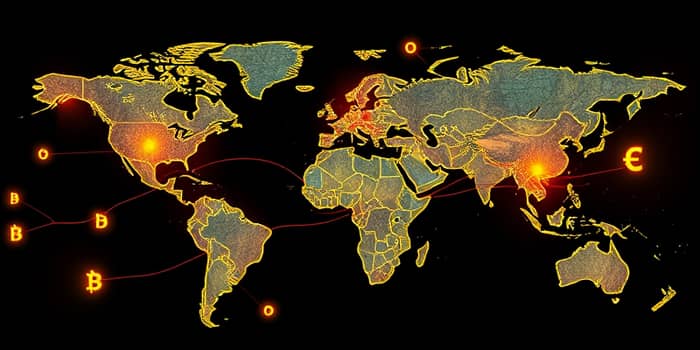
The global forex market stands as the largest financial marketplace, constantly evolving in response to economic shifts and policy changes. As of April 2025, average daily global forex trading volume reached $9.6 trillion, marking a 28% jump from 2022 levels and reflecting unprecedented activity. When annualized, this equates to roughly $3.5 quadrillion traded per year, up from $2.73 quadrillion just three years prior. This staggering scale underpins countless industries, from multinational corporations hedging currency risk to individual traders seeking profit from near-instantaneous price fluctuations.
In an era of renewed economic uncertainty and tariff shocks, forex markets have become a focal point for investors and policymakers alike. Volatility has surged, driving a wave of hedging activity around the globe and promising both opportunity and risk for those ready to engage.
Forex trading is concentrated in a handful of global centers. The United States, United Kingdom, Singapore, Hong Kong, and Japan together account for 78% of total turnover. London remains preeminent, responsible for 37% of global volume, a testament to its enduring infrastructure and deep liquidity pools.
Meanwhile, the U.S. has climbed to second place, capturing nearly 18% of daily volume, with average turnover rising from $1.9 trillion to $2.3 trillion between 2022 and 2025. Singapore’s share grew modestly, while Hong Kong and Japan saw slight declines. These shifts illustrate how geopolitical developments and local regulatory changes can reshape the competitive landscape.
The U.S. dollar remains reserve currency of the world, holding a 56.32% share of global reserves in November 2025. It underpins half of international loans and bonds, and nearly 90% of all FX transactions involve the greenback. In April 2025 alone, daily dollar trading volume exceeded $8.56 trillion, a 29.7% increase from 2022.
This dominance persists despite periodic dips in value. Central banks and institutions remain firmly anchored to the dollar, ensuring its status as the world’s primary reference currency. Even when the dollar’s share dips slightly, its deep liquidity and unmatched market depth quickly restore it to prominence.
Beyond the dollar, several currencies have recorded remarkable gains. The euro saw daily trading volume reach $2.77 trillion in April 2025, up 21.3% from 2022, though its market share fell from 30.6% to 28.9%. The Chinese yuan outperformed all others, surging 55.9% to $817 billion, driven by expanding currency swap arrangements.
Other notable movers include the British pound and Japanese yen, which experienced fluctuations tied to monetary policy decisions. Yet the overall trend points to a losing dominance in global transactions by the traditional seven major pairs, whose combined share fell from 85% in 2022 to 66.3% in 2025.
Volume concentration in the top pairs remains formidable. The EUR/USD pair leads all others, generating a daily average of $2.03 trillion, or 21.2% of total turnover. USD/CNY follows, with $781.3 billion traded daily—a 58% increase from 2022 that cements its status as the fastest-growing major pair.
This concentration underscores both opportunity and risk. High liquidity means narrower spreads and reliable execution, but also fierce competition from high-frequency and institutional traders.
Forex trading extends well beyond simple spot transactions. Foreign exchange swaps dominated in 2025, accounting for 41.5% of total volume with $3.99 trillion traded daily, although their share has declined from historical highs.
Spots surged 22.3% year-over-year, reaching $13.25 trillion in April 2025. Forwards climbed 23.7% to $5.98 trillion, while swaps and OTC options also marked double-digit gains.
These developments reflect a market embracing rapidly evolving trading instruments, where participants tailor strategies to match risk appetite and regulatory constraints.
Success in forex trading demands more than understanding raw numbers. It requires disciplined strategy, robust analysis, and stringent risk controls. Below are key principles every trader should adopt:
Novice traders should start with demo accounts, mastering platform mechanics without financial exposure. Seasonal volatility—around central bank meetings and major economic releases—offers both risk and reward. By staying informed and agile, traders can navigate turbulent markets and turn uncertainty into opportunity.
Ultimately, forex trading is a journey. Embrace both the scale of the market and the subtle forces at play in every currency pair. With disciplined execution, ongoing education, and effective risk management, you can position yourself to harness the world’s most liquid and dynamic financial marketplace.
References